Pastor Phone

Pastor Brian Bucklew
graceneligh@gmail.com
Worship time: Sundays at 10:30 a.m. Sunday School at 9:30 a.m.
Showing posts with label Commemorations. Show all posts

Thursday, October 15, 2015

Dancing on the Devil's Grave

An article from the Lutheran Witness that is worth reading.


William M. Cwirla

Halloween has become a major commercial holiday in this country, second in potential profit making only to the Christmas season. The average American family now spends well over $100 each year in tricks, treats, and scary decorations.

What do we Christians do with Halloween? Is it innocent fun or something to avoid?

HISTORY

Halloween is short for All Hallows Eve, that is, the evening before All Saints Day, a Christian holy day on which Christians honored the saints (the “hallowed” ones), the heroes and martyrs of the faith. For Lutherans, All Hallows Eve is also Reformation Day, the day Martin Luther posted his 95 Theses for debate on the door of the Castle Church at Wittenberg.

In the Middle Ages, people had a profound sense of the demonic. Just think of Luther’s Reformation hymn, “A Mighty Fortress:” “Though devils all the world should fill, all eager to devour us.” People believed that the demons were especially active on the eve of All Hallows. People carved gourds with ugly faces and set them out to guard their homes. This was similar to the practice of carving grotesque gargoyles on the drain spouts of cathedrals to ward off devils. People paraded in the streets dressed up in costumes and masks to confuse the demons and confound their schemes.

The holy day of All Saints has all but died out, especially in Protestant Christianity, which barely recognizes the saints let alone honors them. Popular culture has latched on to All Hallows Eve and turned it into another money-making gimmick. Much of the fun is innocent, albeit bad for the teeth. Children dress up as Power Rangers, ballerinas, and SpongeBob SquarePants and gorge themselves with candy begged from the neighbors under special dispensation from parents and dentists.

There is a darker, more sinister side to Halloween, however. Satanic and pagan groups have made Halloween their own special “high holy day.” Animal shelters warn owners of black cats to keep them indoors so they are not harmed. A night that was once a confrontation with the devil has become a celebration of all things devilish. The old nature always prefers the darkness to the Light.

Ought Christians participate? The easy answer would be a flat out, fundy “no.” But every road has two ditches, and Halloween is no exception.

ON THE ONE SIDE

There is the danger of taking death and the devil too lightly. Make no mistake: The devil is real. He isn’t some red guy with a pointy tail and a pitchfork. He is a liar, the father of lies, and a murderer. He masquerades as an angel of light, appearing to be very religious in order to deceive people and draw their focus away from Jesus Christ (2 Cor. 11:14).

A baptized believer belongs entirely to the Lord and has no fellowship with the devil and his demons. So when Christians take part in the darker side of Halloween, they may create the false impression that death and the devil are not serious business, or that it’s okay for Christians to dine with the devil once and a while, as long as their spoons are long enough. No faithful Christian who takes sin, death, and devil seriously would want anything to do with that.

ON THE OTHER SIDE

There is the danger of taking the devil too seriously. Contrary to what some impressionable types seem to believe, the devil is not all-powerful, all-knowing, almighty, or present everywhere. He is a fallen angel, a creature of God turned against his Creator. He stands chained and defeated by the death and resurrection of Jesus. He is a liar and a loser, and his only hope with the short time that he has left is to convince the world that Jesus’ death on the cross isn’t enough to save us.

Jesus Christ has conquered death once for all people, once for all time. He has defeated the devil by His death on the cross. We can live in confidence, free from fear of death and the devil, knowing that God is at peace with us in the death of Jesus, that Jesus is risen from the dead and that we, too, will rise. Christ has conquered. The devil is defeated. “He’s judged, the deed is done.”

THE MIDDLE OF THE ROAD

Jesus didn’t hang on a cross so that His Christians could go around with a dour look on their faces judging everyone around them. When Christians become overly critical of Halloween, they may create the false impression that Jesus does not reign now over all things, including the devil, that He has not conquered death by His dying and rising, or that the devil is to be feared more than God.

Sour pietism on the part of Christians confirms the world’s mistaken notion that Christianity is nothing more than a religion of rules ruled by moral nannies who want to suck the fun out of everything. Martin Luther reminded us that we need to spite the devil every chance we get. Luther sure did, often in rather colorful ways. Halloween certainly affords the opportunity to sass the “old, evil foe.”

Having defined the ditches, let’s get back to the question that started this whole discussion. Ought Christians participate in Halloween? It all depends. Of course, I don’t expect baptized believers in Jesus Christ to be dancing in the woods around bonfires while chanting pagan prayers to the mother goddess or sacrificing black cats, ecumenical liberalism notwithstanding. On the other hand, the devil’s chief work is to draw us away from Christ’s death and resurrection and have us focus on our works, prayers, and piety. He seems to be doing a pretty decent job of that in mega-Christianity. Generally speaking, the cultural silliness associated with Halloween has about as much to do with the devil as Christmas has to do with the incarnation of the Son of God.

HOW DO WE DECIDE?

Love of neighbor and concern for his or her salvation will give us pause for a few questions. What will your neighbor, your family, your children, your brother or sister in Christ think of your Halloween celebration? Will it help or hinder their faith in Jesus? Does your Halloween fun witness to the victory and freedom of Jesus’ death and resurrection, or does it lift up the powers of darkness and death? Does it draw undue attention to the dark and demonic, or does it poke fun at those things that already stand defeated? Are you able to talk frankly about the reality of death and the devil with your children and tell them of the victory of Jesus?

Freedom in Christ is always tempered by love for your neighbor. You are completely free in Jesus to serve your neighbor in love (Rom. 14:1–23).

In the end, you must decide for yourself how and to what extent you and your family will participate in Halloween festivities. Context is important. Local mileage may vary. The best advice I can give is to spite the devil, honor Christ, and wipe that sour look off your face. Remember who you are in Holy Baptism: a baptized priest in Christ’s holy priesthood “that you may declare the wonderful deeds of Him who called you out of darkness into his marvelous light” (1 Peter 2:9).

—

About the Author: Rev. William M. Cwirla is pastor of Holy Trinity Lutheran Church in Hacienda Heights, Calif.

October 2010

Tuesday, May 12, 2015

Ascension Day Service, 7:30 Thursday, May 14

Grace Lutheran Church will be having Ascension Day service with the Lord's Supper 7:30PM this Thursday, May 14.  Join us to hear about our Lord's Ascension and the comfort it brings.  The sermon will be a sermon written by Pastor Marty Measel (former vicar) as published in Concordia Pulpit Resources.

A little about Ascension Day from Treasury of Daily Prayer: Ascension Day is the coronation celebration of our Lord as He is proclaimed to be King of the universe. Jesus' ascension to the Father is His entrance to the greater existence beyond the confines of time and space, being no longer bound by the limitations of His state of humiliation.  Jesus now sits at the right hand of God, which Luther correctly taught is everywhere, having again taken up the power and authority that were His since before time.  Yet our Lord is present with us who remain bound by time and space.  He is with us as true God and true man, exercising His rulership in the Church through the means of grace which He established: His Word and His Sacraments.  We mortals in those means of grace can grasp the King of the universe and receive a foretaste of the feast to come.

Friday, October 31, 2014

Tuesday, December 17, 2013

O Come, O Come Emmanuel

An excellent article, reprinted below, on the O Antiphons and hymn "O Come, O Come Emmanuel" posted by Pastor Joseph Abrahamson at Steadfast Lutherans.  Today starts the last seven days before Christmas.

The “O Antiphons”


The hymn “O, Come, O, Come, Emmanuel” (TLH 62; LW 31; CW 32; ; ELH 110; LSB 357) is a rendition of the medieval “O Antiphons” also called the “Greater Antiphons.” An Antiphon is a selection of Scripture and prayer chanted responsively by the officiant and assembly. The purpose of the Antiphon is to set the focus for the reading selected for that particular day of the Church year.

The O Antiphons were to be sung during Vespers one on each day seven days before the feast of the Nativity of Christ: that is, from December 17th through the 23rd. Each Antiphon focuses on a Scriptural title for Christ as He is named in Biblical prophecy and a petition to Christ to come fulfilling the promise made through that title and prophecy.

The Messianic prophecies in Isaiah form the heart of the seven antiphons, which draw particularly on Isaiah 11.

The traditional order of the seven antiphons is

(1) Sapientia: “O Wisdom” Isaiah 11:2-3,
(2) Adonai: “O Lord of Might” Isaiah 11:4-5,
(3) Radix Jesse: “O Root/Branch/Rod of Jesse” Isaiah 11:1 and 10,
(4) Clavis David: “O Key of David” Isaiah 22:22,
(5) Oriens: “O Dayspring” Isaiah 9:2,
(6) Rex Gentium: “O Desire of Nations/King of Gentiles” Isaiah 2:4; 9:6; 11:10-12,
(7) Emmanuel: “O Emmanuel” Isaiah 7:14.

When one takes first letters of the titles for Christ in the antiphons and reads them from right to left they form a Latin acrostic “Ero Cras” which means “I will be (with you) tomorrow” or “I will come tomorrow”–a thematically appropriate mnemonic.

The basic progression of themes can be understood this way: The framer of the Universe (Wisdom) Who gave the Law (Adonai) promised through David’s throne (Radix Jesse) to set free the captives of sin (Clavis David) and bring the Light of salvation to dawn (Oriens) not only on His chosen people but all nations (Rex Gentium) and dwell with us as one of us eternally (Emmanuel).

The basic petition through all the verses is an echo of the closing two passages of Scripture looking forward to the consummation of all things:

20 He who testifies to these things says, “Surely I am coming quickly.”
Amen. Even so, come, Lord Jesus!
21 The grace of our Lord Jesus Christ be with you all. Amen.

The Latin text that forms the basis for the hymn dates back at least to manuscripts from the 11th century. Based on their use in an Old English poem called “The Christ” by Cynewulf the antiphons probably date from the 8th century or earlier. Amalarius of Metz (780-850) a student of Alquin wrote that the antiphon “O Key of David” was used for Alquin’s funeral in 804 (in Thurston, p. 622).

The order of the antiphons was rearranged for the hymn “O, Come, O, Come, Emmanuel” as we see in LW 31, ELH 110, and LSB 357 by placing the 7th antiphon first. Indeed, TLH 62 (followed by Christian Worship 23) included only four verses of the original in the order 7354. The Norwegian Synod’s Lutheran Hymnary included five verses in the order 73542. This puzzling arrangement and choice of verses came about because of the choices of the man who translated them into English.

The translator for the most widely accepted English versions of the antiphons was John Mason Neale in his 1859 Hymns Ancient and Modern where he translated only five antiphons in the order 73542 (Hymn 47, p. 67). He had previously translated these same verses in his 1851 Medieval Hymns and Sequences with the words “Draw nigh, draw nigh, Emmanuel” (p. 171-172). By Neale’s time he transcribed the use of the plainsong melody called Veni Emmanuel. The Norwegian Synod’s Lutheran Hymnary used the tune St. Petersburg by Dmytri Borniansky.

God willing, on each of the next seven days of Advent, December 17 through 23 we will post each of the O Antiphons with their Scriptural sources. We hope this will be of value to your families in your devotional preparations for the Nativity of Christ.

Resources:
Anglicans Online A reflection on the O Antiphons.

Burgert, Edward (1921) The Dependence of Part I of Cynewulf’s Christ Upon the Antiphonary. J. D. Milans and Sons, Washington, DC.
[Discussion on the O Antiphons in Cynewulf's poem "Christ" in greater detail is found in pp. 55-66. Incidentally, for fans of J.R.R. Tolkien this poem of Cynewulf not only describes the O Antiphons, but  lines 104-5, contain these word:

"Eala earendel,         engla beorhtast,
ofer middangeard         monnum sended,"

"Hail Earendel     brightest of angels
Above Middle-earth     sent unto men."
]

Evangelical Lutheran Hymnary Handbook (Online Draft edition) Hymns starting MNO.

Dahle, John Library of Christian Hymns hymn 172 of the Lutheran Hymnary (1913).

Gree, Everard (1885) “On the words O Sapientia in the Calendar.” Archaeologia, Society of Antiquaries of London: volume 49:219-242.

Henry, H. (1911). “O Antiphons”. In The Catholic Encyclopedia. New York: Robert Appleton Company. Retrieved December 5, 2013 from New Advent: http://www.newadvent.org/cathen/11173b.htm

Polack, W.G [compiler] (1942) Handbook to The Lutheran Hymnal CPH, St. Louis, p. 50.

Staley, Vernon (1907) The Liturgical Year: An Explanation of the Origin, History & Significance of the Festival Days & Fasting Days of the English Church. A.R. Mowbray, London.
[Staley's history of the development of Advent begins on p. 64, treating the The O Antiphons on pp. 70-71. The O Antiphons are listed with Scripture references in Appendix A, p. 219-20.]

The Hymns and Carols of Christmas: O Come, O Come, Emmanuel.

Thurston, Herbert (1905)  “The Great Antiphons, Heralds of Christmas.” The Month: A Catholic Magazine, Longman, Greens and Co, London. vol 106:616-631.
[This article has some very good historical research on the early development of Advent and the O Antiphons]

Thursday, April 18, 2013

It was on this day, April 18, 492 years ago that Martin Luther gave testimony at the Diet of Worms, saying those famous words, "Here I stand, I can do no other."  Here is a short clip from the old Martin Luther movie.  Enjoy this faithful man's stand for truth.


Here is Christian Cyclopedia's description of the Diet of Worms:

"First diet called by young Emperor Charles V, where April 18, 1521, Luther made world-changing speech refusing to recant. He stood alone on Scripture against pope, prelates, and emperor. The diet also presented the Centum gravamina, “Hundred Grievances,” which German nation had against abuses of papacy. Former diets had made similar protests. This time, as previously, no real reforms were effected. "

Saturday, December 29, 2012

Today the Church Commemorates David

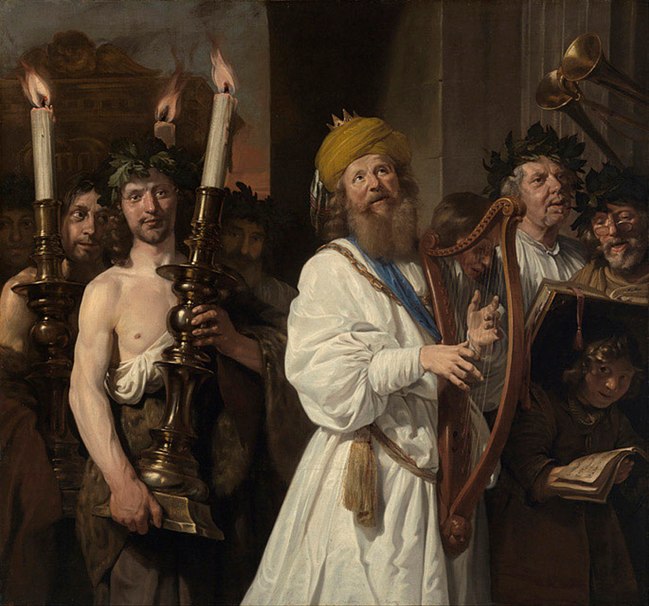
File:David Playing the Harp 1670 Jan de Bray.jpg
David, the greatest of Israel's kings, ruled from about 1010 to 970 B.C. The events of his life are found in 1 Samuel 16 through 1 Kings 2 and in 1 Chronicles 1029. David was also gifted musically. He was skilled in playing the lyre and the author of no less than 73 psalms, including the beloved Psalm 23. His public and private character displayed a mixture of good (for example, his defeat of the giant Goliath, 1 Samuel 17) and evil (as in his adultery with Uriah's wife, followed by his murder of Uriah, 2 Samuel 11). David's greatness lay in his fierce loyalty to God as Israel's military and political leader, coupled with his willingness to acknowledge his sins and ask for God's forgiveness (2 Samuel 12; see also Psalm 51). It was under David's leadership that the people of Israel were united into a single nation with Jerusalem as its capital city.

To listen to an interview of Dr. Dan Gard of Concordia Theological Seminary-Ft. Wayne, IN on David on Issues Etc, click on the Issues Etc logo below.

Friday, December 28, 2012

Today the Church Commemorates The Holy Innocents, Martyrs


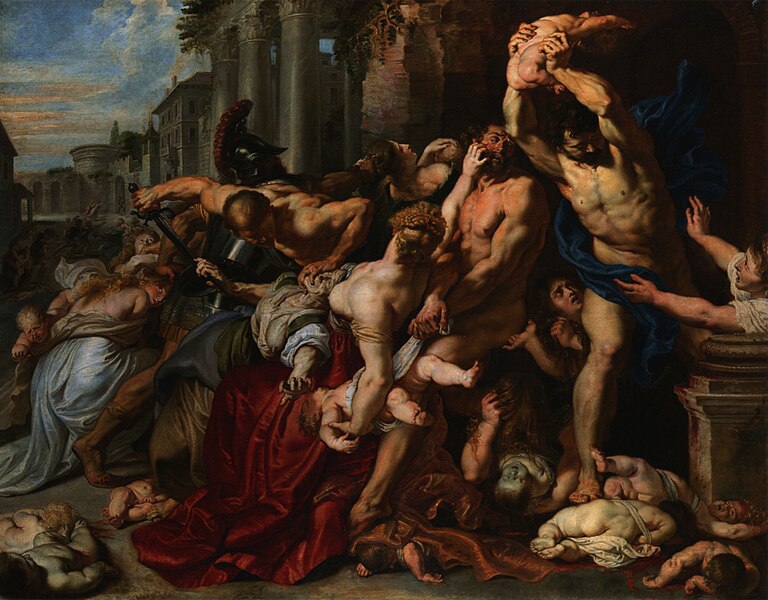
File:Peter Paul Rubens Massacre of the Innocents.jpg
Matthew's Gospel tells of King Herod's vicious plot against the infant Jesus after being "tricked" by the Wise Men.  Threatened by the one "born King of the Jews." Herod murdered all the children in and around Bethlehem who wee two years old or younger (Matthew 2:16-18).  These "innocents," commemorated just three days after the celebration of Jesus' birth, remind us not only of the terrible brutality of which human beings are capable but more significantly of the persecution Jesus endured from the beginning of His earthly life.  Although Jesus' life was providentially spared at this tie, many years later, another ruler, Pontius Pilate, would sentence the innocent Jesus to death.

To listen to an interview of Dr. Peter Scaer of Concordia Theological Seminary-Fort Wayne, IN on The Slaugher of the Innocents on Issues Etc, click on the Issues Etc logo below.


Wednesday, December 26, 2012

Today the Church Commemorates St. Stephen, Martyr


St. Stephen, "a man full of faith and of the Holy Spirit" (Acts 6:5), was one of the Church's first seven deacons.  He was appointed by the leaders of the Church to distribute food and other necessities to the poor in the growing Christian community in Jerusalem, thereby giving the apostles more time for their public ministry of proclamation (Acts 6:2-5).  He and the other deacons apparently were expected not only to wait on tales but also to teach and preach.  When some of his colleagues became jealous of him, they brought Stephen to the Sanhedrin and falsely charged him with blaspheming against Moses (Acts 6:9-14).  Stephen's confession of faith, along with his rebuke of the members of the Sanhedrin for rejecting their Messiah and being responsible for His death, so infuriated them that they dragged him out of the city and stoned him to death.  Stephen honored as the Church's first martyr and for his words of commendation and forgiveness as he lay dying: "Lord Jesus, receive my spirit" and "Lord, do no hold this sin against them" (Acts 7:59-60).

To listen to an interview of Dr. Jeff Kloha of Concordia Seminary-St. Louis, MO on St. Stephen, Martyr on Issues Etc, click on the Issues Etc logo below.

Friday, December 21, 2012

Today the Church Commemorates St Thomas, Apostle


File:Caravaggio - The Incredulity of Saint Thomas.jpg
All four Gospels mention St. Thomas as one of the twelve disciples of Jesus.  John's Gospel, which names him "the Twin," uses Thomas's questions to reveal truths about Jesus.  It is Thomas who says, "Lord, we do not know where You are going.  How can we know the way?"  To this question Jesus replies, "I am the way, and the truth, and the life" (John 14:5-6).  John's Gospel also tells how Thomas, on the evening of the day of Jesus' resurrection, doubts the report of the disciples that they had seen Jesus.  Later, "doubting Thomas" becomes "believing Thomas" when he confesses Jesus as "my Lord and my God" (John 20: 24-29).  According to tradition, Thomas traveled eastward after Pentecost, eventually reaching India, where still today a group of people call themselves "Christians of St. Thomas."  Thomas was martyred for the faith by being speared to death.

To listen to an interview of Dr. Peter Scaer of Concordia Theological Seminary-Ft. Wayne, IN on The Apostle Thomas on Issues Etc, click on the Issues Etc logo below.
http://www.podtrac.com/pts/redirect.mp3/issuesetc.org/podcast/647122110H1S1.mp3

Thursday, December 20, 2012

Today the Church Commemorates Katharina von Bora Luther


Katharina von Bora (1499-1552) was placed in a convent when still a child and became a nun in 1515. In April 1523 she and eight other nuns were rescued from the convent and brought to Wittenberg. There Martin Luther helped return some to their former homes and placed the rest in good families. Katharina and Martin were married on June 13, 1525. Their marriage was a happy one and blessed with six children. Katharina skillfully managed the Luther household, which always seemed to grow because of his generous hospitality. After Luther's death in 1546, Katharina remained in Wittenberg but lived much of the time in poverty. She died in an accident while traveling with her children to Torgau  in order to escape the plague.

Wednesday, December 19, 2012

Today the Church Commemorates Adam and Eve

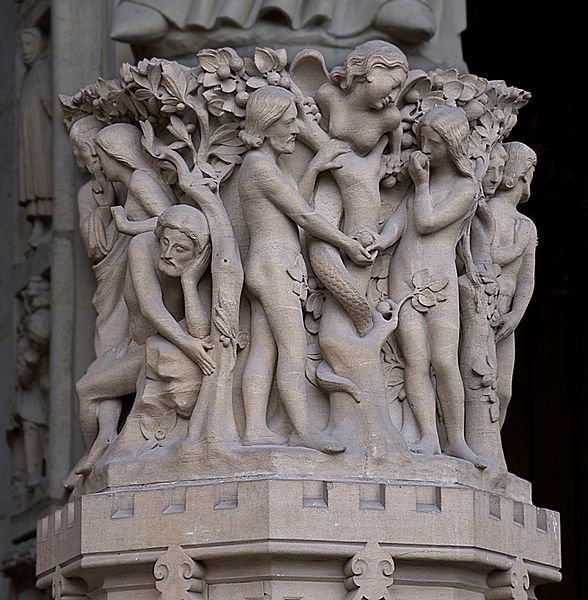
File:Temptation Adam Eva.jpg
Adam was the first man, made in the image of God and given dominion over all the earth (Gen 1:26). Eve was the first woman, formed from one of Adam's ribs to be his companion and helper (2:1824). God placed them in the Garden of Eden to take care of the creation as his representatives. But they forsook God's Word and plunged the world into sin (3:17). For this disobedience God drove them from the Garden. Eve had to suffer the pain of childbirth and be subject to Adam; Adam had to toil amid thorns and thistles and return to the dust of the ground. Yet God promised that the woman's Seed would crush the serpent's head (3:824). Sin had entered God's perfect creation and changed it until God would restore it again through Christ. Eve is the mother of the human race, while Adam is representative of all humanity and the Fall, as St. Paul writes, For in Adam all die, so also in Christ shall all be made alive (1 Cor. 15:22).

To listen to an interview of Dr. David Adams of Concordia Seminary-St. Louis, MO on Adam and Eve on Issues Etc, click on the Issues Etc logo below.

Monday, December 17, 2012

Today the Church Comemorates Daniel the Prophet and the Three Young Men

File:Daniellion.jpg
Daniel the prophet and the Three Young Men—Shadrach, Meshach, and Abednego—were among the leaders of the people of Judah who were taken into captivity in Babylon. Even in that foreign land they remained faithful to the one true God in their piety, prayer, and life. On account of such steadfast faithfulness in the face of pagan idolatry, the Three Young Men were thrown into a fiery furnace, from which they were saved by the Lord and emerged unharmed (Daniel 3). Similarly, Daniel was thrown into a pit of lions, from which he also was saved (Daniel 6). Blessed in all their endeavors by the Lord—and in spite of the hostility of some—Daniel and the Three Young Men were promoted to positions of leadership among the Babylonians (Dan 2:48–49; 3:30; 6:28). To Daniel in particular the Lord revealed the interpretation of dreams and signs that were given to King Nebuchadnezzar and King Belshazzar (Daniel 2, 4, 5). To Daniel himself the Lord gave visions of the end times.

To listen to an interview of Dr. Andrew Steinmann of Concordia University-Chicago on The Prophet Daniel and the Three Young Men on Issues Etc, click on the Issues Etc logo below.

Thursday, December 13, 2012

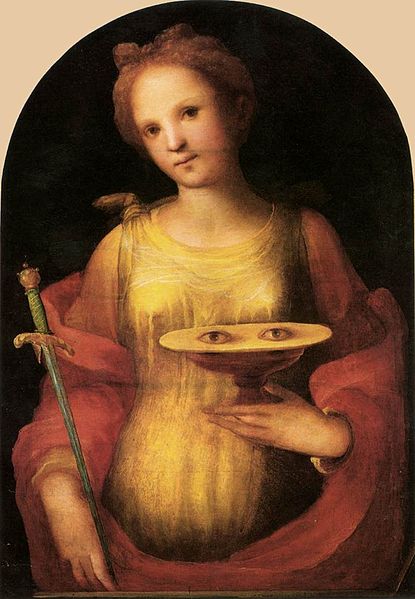
Today the Church Commemorates Lucia, Martyr

File:Saint Lucy by Domenico di Pace Beccafumi.jpg
One of the victims of the great persecution under the Roman emperor Diocletian, Lucia met her death at Syracuse on the island of Sicily in the year A.D. 304, because of her Christian faith. Known for her charity, “Santa Lucia” (as she is called in Italy) gave away her dowry and remained a virgin until her execution by the sword. The name Lucia means “light,” and, because of that, festivals of light commemorating her became popular throughout Europe, especially in the Scandinavian countries. There her feast day corresponds with the time of year when there is the least amount of daylight. In artistic expression she is often portrayed in a white baptismal gown, wearing a wreath of candles on her head.

To listen to an interview of Pastor Heath Curtis of Trinity Lutheran-Worden, IL on The 4th Century Martyr St. Lucia on Issues Etc, click on the Issues Etc logo below.

Friday, December 7, 2012

Today the Church Commemorates Ambrose of Milan, Pastor and Hymnwriter

File:AmbroseGiuLungara.jpg
Born in Trier in A.D. 340, Ambrose was one of the four great Latin Doctors of the Church (with Augustine, Jerome, and Gregory the Great). He was a prolific author of hymns, the most common of which is Veni, Redemptor gentium (“Savior of the Nations, Come”). His name is also associated with Ambrosian Chant, the style of chanting the ancient liturgy that took hold in the province of Milan. While serving as a civil governor, Ambrose sought to bring peace among Christians in Milan who were divided into quarreling factions. When a new bishop was to be elected in 374, Ambrose addressed the crowd, and someone cried out, “Ambrose, bishop!” The entire gathering gave their support. This acclaim of Ambrose, a 34-year-old catechumen, led to his baptism on December 7, after which he was consecrated bishop of Milan. A strong defender of the faith, Ambrose convinced the Roman emperor Gratian in 379 to forbid the Arian heresy in the West. At Ambrose's urging, Gratian's successor, Theodosius, also publicly opposed Arianism. Ambrose died on Good Friday, April 4, 397. As a courageous doctor and musician he upheld the truth of God's Word.

To listen to an interview of Pastor Will Weedon of St. Paul Lutheran-Hamel, IL on 4th Century Bishop of Milan, St. Ambrose on Issues Etc, click on the Issues Etc logo below.

Thursday, December 6, 2012

Today the Church Commemorates Nicholas of Myra, Pastor

File:ST NICHOLAS.jpg
Of the many saints commemorated by the Christian Church, Nicholas (d. A.D. 342) is one of the best known. Very little is known historically of him, although there was a church of Saint Nicholas in Constantinople as early as the sixth century. Research has affirmed that there was a bishop by the name of Nicholas in the city of Myra in Lycia (part of Turkey today) in the fourth century. From that coastal location, legends about Nicholas have traveled throughout time and space. He is associated with charitable giving in many countries around the world and is portrayed as the rescuer of sailors, the protector of children, and the friend of people in distress or need. In commemoration of “Sinte Klaas” (Dutch for Saint Nicholas, in English “Santa Claus”), December 6 is a day for giving and receiving gifts in many parts of Europe.

To listen to an interview of Pastor Will Weedon of St. Paul Lutheran-Hamel, IL on Nicholas of Myra on Issues Etc, click on the Issues Etc logo below.

Tuesday, December 4, 2012

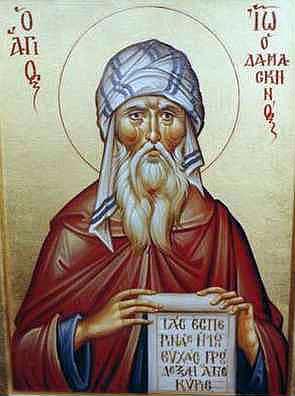
Today the Church Commemorates John of Damascus, Theologian and Hymnwriter

File:John-of-Damascus 01.jpg
John (ca. 675–749) is known as the great compiler and summarizer of the orthodox faith and the last great Greek theologian. Born in Damascus, John gave up an influential position in the Islamic court to devote himself to the Christian faith. Around 716 he entered a monastery outside of Jerusalem and was ordained a priest. When the Byzantine emperor Leo the Isaurian in 726 issued a decree forbidding images (icons), John forcefully resisted. In his Apostolic Discourses he argued for the legitimacy of the veneration of images, which earned him the condemnation of the Iconoclast Council in 754. John also wrote defenses of the orthodox faith against contemporary heresies. In addition, he was a gifted hymnwriter (“Come, You Faithful, Raise the Strain”) and contributed to the liturgy of the Byzantine churches. His greatest work was the Fount of Wisdom which was a massive compendium of truth from previous Christian theologians, covering practically every conceivable doctrinal topic. John's summary of the orthodox faith left a lasting stamp on both the Eastern and Western churches.

To listen to an interview of Pastor Heath Curtis of Trinity Lutheran-Worden, IL on John of Damascus on Issues Etc, click on the Issues Etc logo below.


To listen to an interview of Dr. Bill Weinrich of Concordia Theological Seminary-Ft. Wayne, IN on John of Damascus on Issues Etc, click on the Issues Etc logo below.

Friday, November 30, 2012

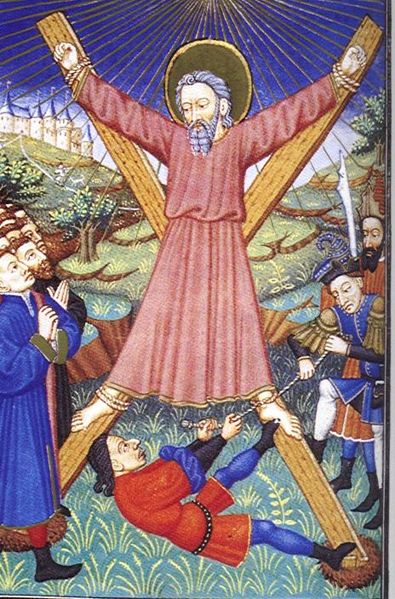
Today the Church Commemorates St Andrew, Apostle


File:Martyrdom of andrew.jpg   File:Saint Andreas.jpg
St. Andrew, the brother of Simon Peter, was born in the Galilean village of Bethsaida.  Originally a disciple of St. John the Baptist, Andrew then became the first of Jesus’ disciples (John 1:35-40).  His name regularly appears in the Gospels near the top of the lists of the Twelve.  It was he who first introduced his brother Simon to Jesus (John 1:41-42).  He was, in a real sense, the first home missionary, as well as the first foreign missionary (John 12:20-22).  Tradition says Andrew was martyred by crucifixion on a cross in the born of an X.  In AD 357, his body is said to have been taken to the Church of the Holy Apostles in Constantinople and later removed to the cathedral of Amalfi in Italy.  Centuries later, Andrew became the patron saint of Scotland.  St. Andrew’s Day determines the beginning of the western Church year, since the Fist Sunday in Advent is always the Sunday nearest to St. Andrew’s Day.  

Thursday, November 29, 2012

Today the Church Commemorates Noah


Noah, the son of Lamech (Gen 5:30), was instructed by God to build an ark, in which his family would find security from the destructive waters of a devastating flood that God warned would come. Noah built the ark, and the rains descended. The entire earth was flooded destroying every living thing that was on the face of the ground, both man and beast (7:23). After the flood waters subsided, the ark came to rest on the mountains of Ararat. When Noah determined it was safe, and God confirmed it, he and his family and all the animals disembarked. Then Noah built an altar and offered a sacrifice of thanksgiving to God for having saved his family from destruction. A rainbow in the sky was declared by God to be a sign of His promise that never again would a similar flood destroy the entire earth (8;20). Noah is remembered and honored for his obedience, believing that God would do what He said He would.

To listen to an interview of Dr. Joel Heck of Concordia University-Texas on Noah on Issues Etc, click on the Issues Etc logo below.


To listen to an interview of Dr. Nathan Jastram of Concordia University Wisconsin on Noah on Issues Etc, click on the Issues Etc logo below.


Friday, November 23, 2012

Today the Church Commemorates Clement of Rome, Pastor

File:San Clemente de Roma.jpg
Clement (ca. A.D. 35-100) is remembered for having established the pattern of apostolic authority that governed the Christian Church during the first and second centuries. He also insisted on keeping Christ at the center of the Church's worship and outreach. In a letter to the Christians at Corinth, he emphasized the centrality of Jesus' death and resurrection: Let us fix our eyes on the blood of Christ, realizing how precious it is to His Father, since it was poured out for our salvation and brought the grace of repentance to the whole world (1 Clement 6:31). Prior to suffering a martyr's death by drowning, he displayed a steadfast, Christ-like love for God's redeemed people, serving as an inspiration to future generations to continue to build the Church on the foundation of the prophets and apostles, with Christ as the one and only cornerstone.

To listen to an interview of Dr. Bill Weinrich of Concordia Theological Seminary-Ft. Wayne, IN on Clement of Rome on Issues Etc, click on the Issues Etc logo below.


To listen to an interview of Pastor Heath Curtis of Trinity Lutheran-Worden, IL on Clement of Rome on Issues Etc, click on the Issues Etc logo below.