Pastor Phone

Pastor Brian Bucklew
graceneligh@gmail.com
Worship time: Sundays at 10:30 a.m. Sunday School at 9:30 a.m.

Thursday, December 13, 2012

Today the Church Commemorates Lucia, Martyr

File:Saint Lucy by Domenico di Pace Beccafumi.jpg
One of the victims of the great persecution under the Roman emperor Diocletian, Lucia met her death at Syracuse on the island of Sicily in the year A.D. 304, because of her Christian faith. Known for her charity, “Santa Lucia” (as she is called in Italy) gave away her dowry and remained a virgin until her execution by the sword. The name Lucia means “light,” and, because of that, festivals of light commemorating her became popular throughout Europe, especially in the Scandinavian countries. There her feast day corresponds with the time of year when there is the least amount of daylight. In artistic expression she is often portrayed in a white baptismal gown, wearing a wreath of candles on her head.

To listen to an interview of Pastor Heath Curtis of Trinity Lutheran-Worden, IL on The 4th Century Martyr St. Lucia on Issues Etc, click on the Issues Etc logo below.

Tuesday, December 11, 2012

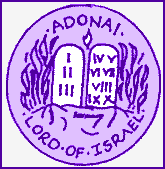
O Come, Adonai

Tomorrow, Wednesday, December 12 we begin our Advent-Christmas Series "O Come, O Come Emmanuel" based on the hymn of the same title with "O Come, Adonai."  Services start at 7:30PM (also 7:30PM on Thursday, December 13 at Trinity Lutheran in Elgin).

The youth will serve supper from 5:30-7:00 as a fundraiser, please support them.

Adonai

O come, O come, Thou Lord of might,
Who to Thy tribes on Sinai's height
In ancient times didst give the Law
In cloud and majesty and awe.
Rejoice! Rejoice!
Emmanuel Shall come to thee, O Israel!

The theme of this Advent–Christmas season is “O Come, O Come Emmanuel,” derived from both the popular hymn.  The popular version, translated by the Rev. John Mason Neale in rhymed poetry, often departs from the original Latin.  Traditionally, one antiphon was chanted on each of the seven days before Christmas.  The antiphons generally derive from the prophecies of Isaiah and follow a rough chronology through history until the coming of Emmanuel, Hebrew for "God [is] with Us" (see Isaiah 7:14; Matthew 1:23)

Friday, December 7, 2012

Today the Church Commemorates Ambrose of Milan, Pastor and Hymnwriter

File:AmbroseGiuLungara.jpg
Born in Trier in A.D. 340, Ambrose was one of the four great Latin Doctors of the Church (with Augustine, Jerome, and Gregory the Great). He was a prolific author of hymns, the most common of which is Veni, Redemptor gentium (“Savior of the Nations, Come”). His name is also associated with Ambrosian Chant, the style of chanting the ancient liturgy that took hold in the province of Milan. While serving as a civil governor, Ambrose sought to bring peace among Christians in Milan who were divided into quarreling factions. When a new bishop was to be elected in 374, Ambrose addressed the crowd, and someone cried out, “Ambrose, bishop!” The entire gathering gave their support. This acclaim of Ambrose, a 34-year-old catechumen, led to his baptism on December 7, after which he was consecrated bishop of Milan. A strong defender of the faith, Ambrose convinced the Roman emperor Gratian in 379 to forbid the Arian heresy in the West. At Ambrose's urging, Gratian's successor, Theodosius, also publicly opposed Arianism. Ambrose died on Good Friday, April 4, 397. As a courageous doctor and musician he upheld the truth of God's Word.

To listen to an interview of Pastor Will Weedon of St. Paul Lutheran-Hamel, IL on 4th Century Bishop of Milan, St. Ambrose on Issues Etc, click on the Issues Etc logo below.

Thursday, December 6, 2012

Today the Church Commemorates Nicholas of Myra, Pastor

File:ST NICHOLAS.jpg
Of the many saints commemorated by the Christian Church, Nicholas (d. A.D. 342) is one of the best known. Very little is known historically of him, although there was a church of Saint Nicholas in Constantinople as early as the sixth century. Research has affirmed that there was a bishop by the name of Nicholas in the city of Myra in Lycia (part of Turkey today) in the fourth century. From that coastal location, legends about Nicholas have traveled throughout time and space. He is associated with charitable giving in many countries around the world and is portrayed as the rescuer of sailors, the protector of children, and the friend of people in distress or need. In commemoration of “Sinte Klaas” (Dutch for Saint Nicholas, in English “Santa Claus”), December 6 is a day for giving and receiving gifts in many parts of Europe.

To listen to an interview of Pastor Will Weedon of St. Paul Lutheran-Hamel, IL on Nicholas of Myra on Issues Etc, click on the Issues Etc logo below.
Tuesday, December 4, 2012

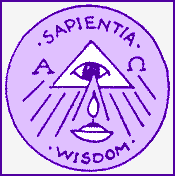
O Come, Wisdom

Tomorrow, Wednesday, December 5 we begin our Advent-Christmas Series "O Come, O Come Emmanuel" based on the hymn of the same title with "O Come, Wisdom."  Services start at 7:30PM (also 7:30PM on Thursday, December 6 at Trinity Lutheran in Elgin).

The youth will serve supper from 5:30-7:00 as a fundraiser, please support them.

O Sapientia

O come, Thou Wisdom from on high,
Who ord'rest all things mightily;
To us the path of knowledge show,
And teach us in her ways to go.
Rejoice! Rejoice!
Emmanuel Shall come to thee, O Israel!

The theme of this Advent–Christmas season is “O Come, O Come Emmanuel,” derived from both the popular hymn.  The popular version, translated by the Rev. John Mason Neale in rhymed poetry, often departs from the original Latin.  Traditionally, one antiphon was chanted on each of the seven days before Christmas.  The antiphons generally derive from the prophecies of Isaiah and follow a rough chronology through history until the coming of Emmanuel, Hebrew for "God [is] with Us" (see Isaiah 7:14; Matthew 1:23)

Today the Church Commemorates John of Damascus, Theologian and Hymnwriter

File:John-of-Damascus 01.jpg
John (ca. 675–749) is known as the great compiler and summarizer of the orthodox faith and the last great Greek theologian. Born in Damascus, John gave up an influential position in the Islamic court to devote himself to the Christian faith. Around 716 he entered a monastery outside of Jerusalem and was ordained a priest. When the Byzantine emperor Leo the Isaurian in 726 issued a decree forbidding images (icons), John forcefully resisted. In his Apostolic Discourses he argued for the legitimacy of the veneration of images, which earned him the condemnation of the Iconoclast Council in 754. John also wrote defenses of the orthodox faith against contemporary heresies. In addition, he was a gifted hymnwriter (“Come, You Faithful, Raise the Strain”) and contributed to the liturgy of the Byzantine churches. His greatest work was the Fount of Wisdom which was a massive compendium of truth from previous Christian theologians, covering practically every conceivable doctrinal topic. John's summary of the orthodox faith left a lasting stamp on both the Eastern and Western churches.

To listen to an interview of Pastor Heath Curtis of Trinity Lutheran-Worden, IL on John of Damascus on Issues Etc, click on the Issues Etc logo below.


To listen to an interview of Dr. Bill Weinrich of Concordia Theological Seminary-Ft. Wayne, IN on John of Damascus on Issues Etc, click on the Issues Etc logo below.